


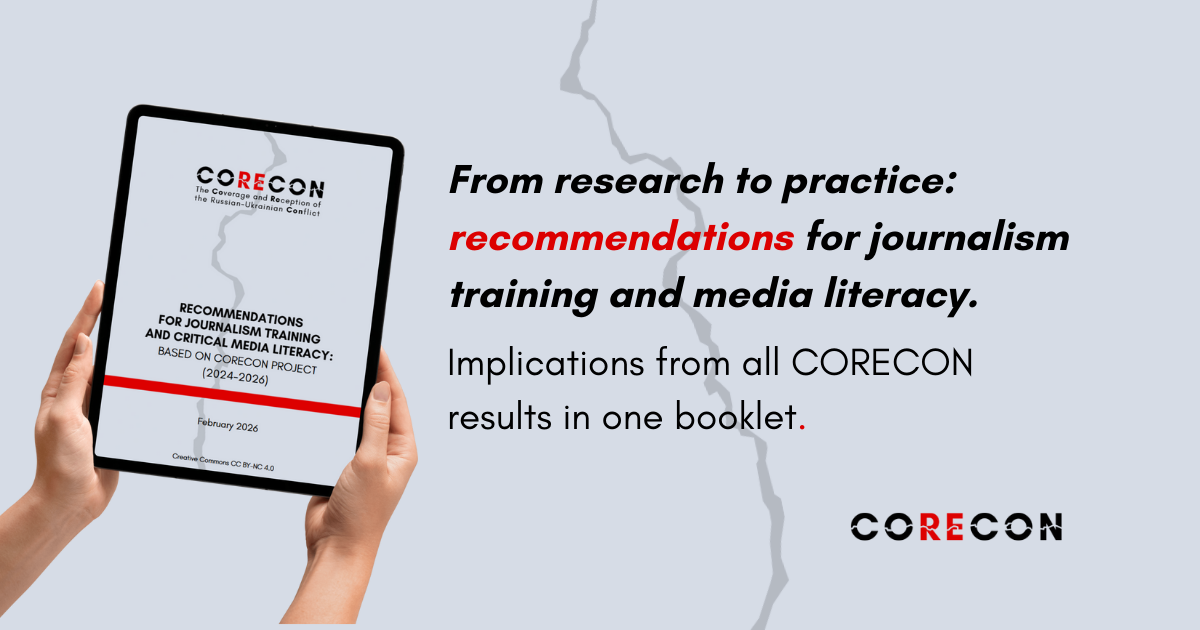
This blogpost showcases the recent online publication that is made available as a CORECON output: Recommendations for Journalism Training and Critical Media Literacy: Based on CORECON Project (2024-2026)
By early 2026, the CORECON project had spawned over two dozen studies. Some studies are comparative and based on the three language-specific media coverage corpora. Others are interpretative smaller-scale studies of specific journalistic genres or political discourses. The full versions of the project’s academic publications can be traced in the project website, in the dedicated “Results” tab: https://grants.ulbsibiu.ro/corecon/results/
With Recommendations for Journalism Training and Critical Media Literacy: Based on CORECON Project (2024-2026) theauthors of these varied analyses and studies aim to contribute to the improvement of responsible and ethical journalism in the context of war and conflict coverage. The material is open access and licensed under Creative Commons 4.0 (by attribution and non-commercial uses only).
The recommendations are grouped into eight thematic sections:
1. ETHICAL COVERAGE OF INTERNATIONAL CONFLICT
2. INCLUSIVE JOURNALISM ON SENSITIVE SOCIAL ISSUES
3. BUSINESS COVERAGE IN CONFLICT OR CRISIS SITUATIONS
4. MANAGING AUDIENCE ENGAGEMENT RESPONSIBLY
5. ETHICS OF MAKING PUBLIC POLITICAL STATEMENTS ON CONFLICT
6. RESPONSIBLE USE OF VISUAL RHETORIC AND AI TECHNOLOGIES
7. CRITICAL MEDIA LITERACY
8. EDUCATING THE YOUTH
CORECON’s reports, events, blogposts, and academic publications have been designed to have multiple implications for practice, including language awareness interventions and assistance or advice for journalistic training and ethical audience engagement strategies.
Overall, this material is to improve communication in the field of international conflict representation and resolution. The conclusions of the critical studies are also meant to spotlight effectively the problematic journalistic practices or latest systemic developments in the area of coverage of war and armed conflicts, and to champion the need for de-amplification, de-sensationalization, or de-stereotyping in conflict coverage.
Readers will also find concrete guidance on how specific linguistic, visual, and narrative choices in conflict reporting shape responsibility, emotional response, and public understanding. The recommendations address issues such as terminological precision, headline construction, source representation, visual framing, metaphor use, and the challenges posed by AI-generated and algorithmically personalized content.
Ideally, this work will offer inspiration for workshops and interventions by giving advice to professionals and amateurs using social media for communicating conflict in a manner suitable for mediation and dialogue. This report can serve as self-study material or an evidence-based guide to building resilience against misinformation.
Text by: Katarzyna Molek-Kozakowska, Robert Radziej