

In October 2025, the inauguration of the People’s Salvation Cathedral in Bucharest established the world’s tallest Orthodox cathedral. Its dome now physically and symbolically towers over the House of the People, the ultimate emblem of Romanian socialism. This monument is merely the most striking example of a broader phenomenon: the construction of over thirty cathedrals and four thousand houses of worship by the Romanian Orthodox Church since 1990. The scale of this expansion not only contrasts sharply with the trend of redundant churches in Western Europe but remains unparalleled across Central and Eastern Europe too. On the one hand, the fast-paced Romanian church-building industry exemplifies the renewed vitality of religious life after socialism. On the other hand, it represents massive employment of public money and the radical transformation of the urban built environment of cities and towns.
This presentation investigates this burgeoning religious infrastructure as a lens into post-communist restructuring.
What lessons can be learned from a church-building industry embedded in the privatisation of state property, branded as an example of economic and touristic development, and carried out to reinforce national belonging?
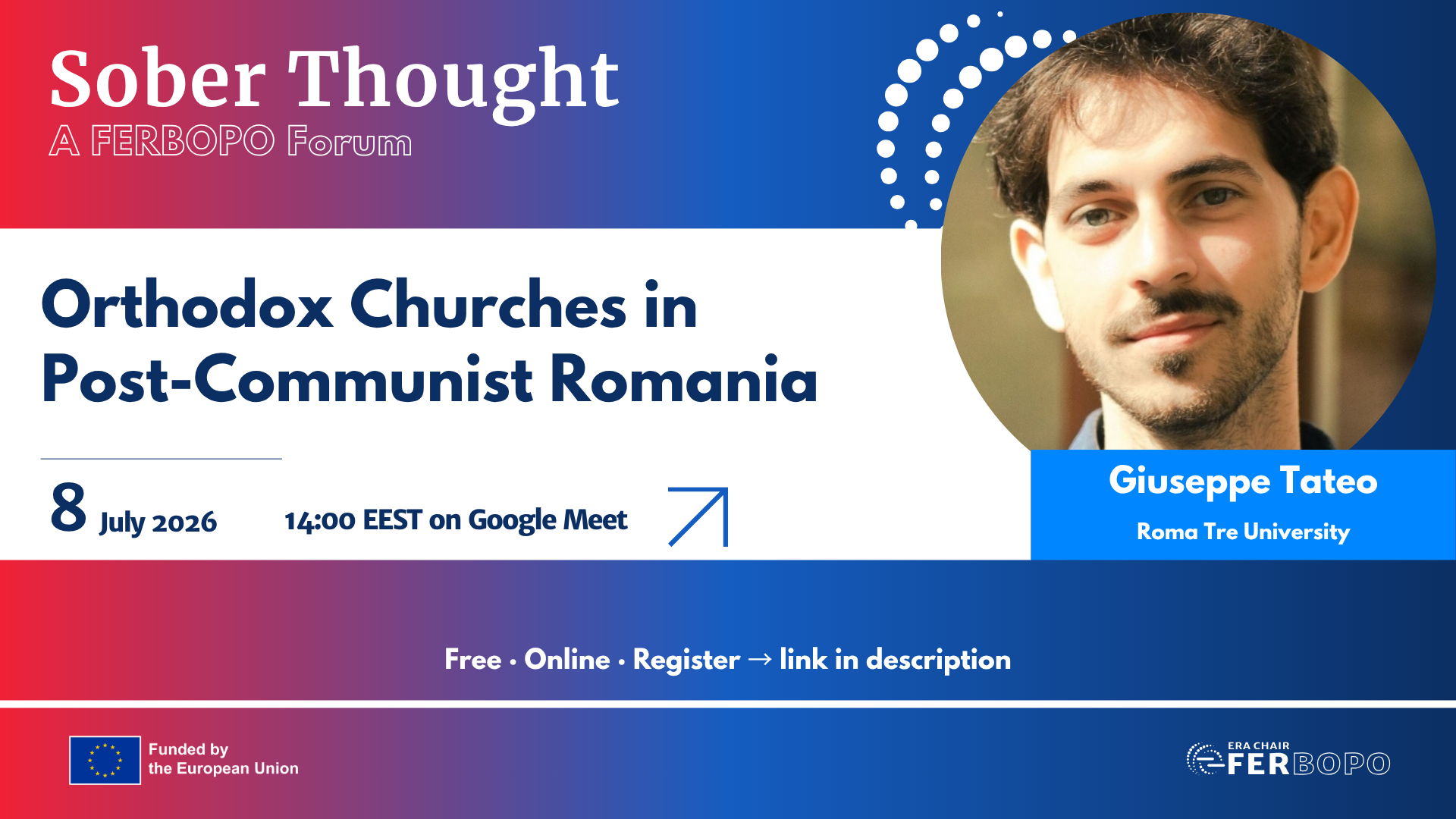
📅 Wednesday, 8 July 2026
🕑 14:00 EEST
✅Register for free → https://forms.gle/tXqkwj7pbTZCkgjG8
💻 Join us online via Google Meet: https://meet.google.com/xvj-ogxd-woc
🎓 Free & open to all
Giuseppe Tateo is a fixed-term assistant professor at Roma Tre University whose research explores the momentous transformation of Christian-Orthodox infrastructure in Romania and eastern Europe. After completing a PhD at the Max Planck Institute for Social Anthropology and holding research and teaching roles in Milan, Bucharest, Prague, and Leipzig, he now serves as a founding member of ShaRP (Laboratory on Shared Religious Places) and associate editor of Anuac: The Journal of the Italian Anthropological Society. His publications include Under the Sign of the Cross. The People’s Salvation Cathedral and the Church-Building Industry in Postsocialist Romania (Berghahn 2020, Romanian translation Polirom 2024) and contributions to Political Theology, The Cambridge Journal of Anthropology, and Hau: Journal of Ethnographic Theory.
Sober Thought: A FERBOPO Forum represents a new series of free online talks exploring the intersections of state, religion, and body politics in Romania and Central and Eastern Europe. Over the coming months, leading scholars will present their work to an open international audience — followed by a live Q&A. Sessions run 60–75 minutes and are free to attend.
This event is part of the Sober Thought series — view all upcoming sessions