About the project
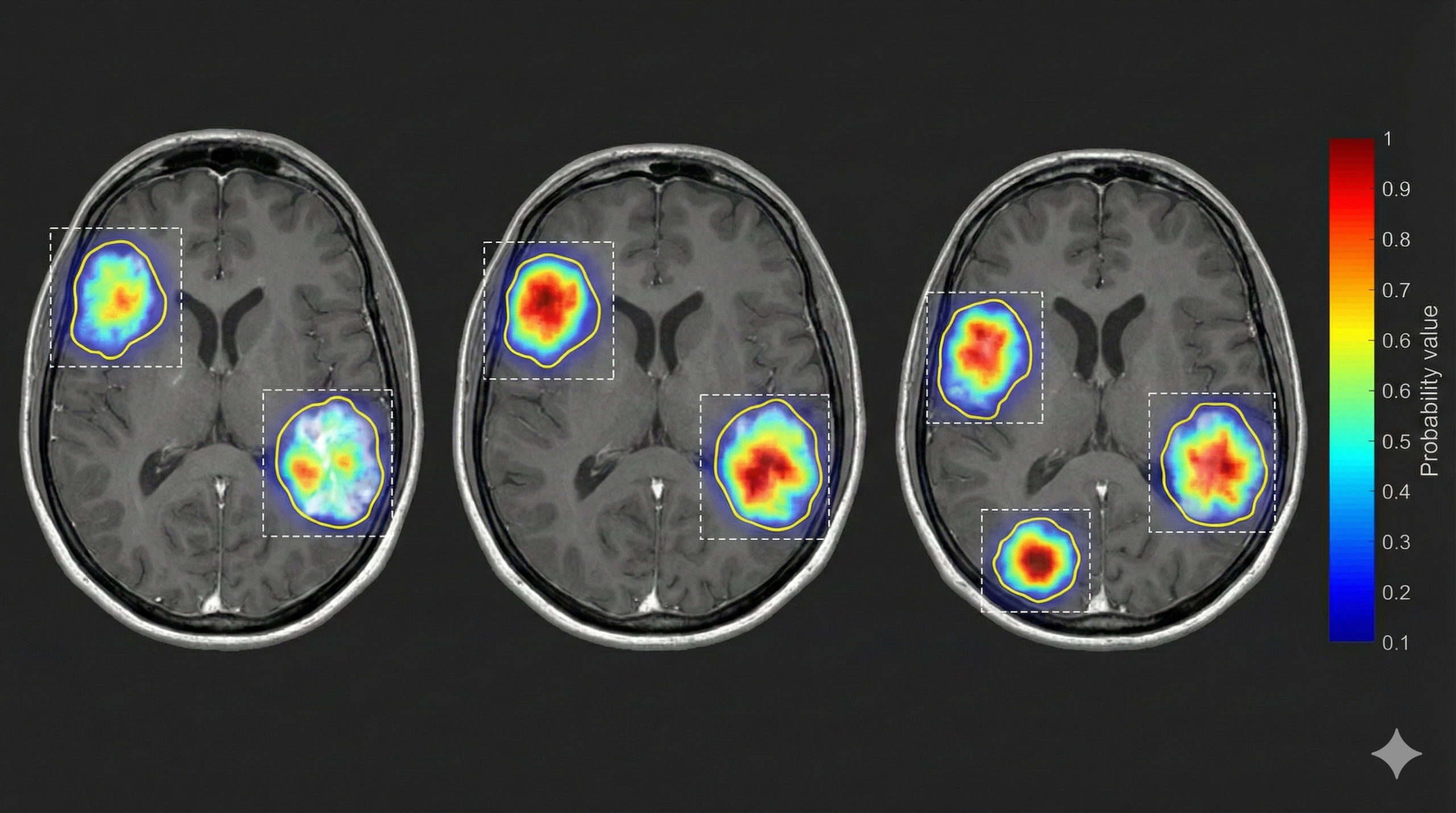
Brain metastases are the most prevalent brain neoplasms, affecting one in five adult cancer patients and accounting for more than half of all intracranial tumors in adults. Early detection and diagnosis are crucial, as untreated lesions can lead to delayed treatment, severe neurological deficits, and reduced overall survival.
Current diagnosis and treatment planning rely heavily on Magnetic Resonance Imaging (MRI), which is labor-intensive and error-prone, particularly in the manual segmentation and tracking of small and numerous lesions. Manual segmentation of brain metastases from MRI scans is time-consuming, with significant variability and sensitivity issues, often leading to missed lesions. There is a critical unmet need for more efficient, accurate, and reliable methods to assist clinicians in diagnosing and monitoring these tumors. To date, no effective solution is available for physicians.
Recent advances in Artificial Intelligence (AI) have shown promise in addressing these challenges. AI-based models have improved the segmentation and detection of brain metastases. However, variability in MRI protocols, data quality, and model generalization remain significant hurdles.
Innovative Approach – A-BEACON Framework
We propose the development of A-BEACON, an AI-based system designed to offer „zero-miss” detection and efficient tracking of brain metastases. Our approach proposes innovative AI methodologies and strategies for Active Test-Time Augmentation (ACTTA) and interpretability-based inductive biases to boost model performance and reliability. Using a multicentric dataset of 914 re-annotated cases, we will train and validate our models. This dataset, selected for its diversity in terms of imaging characteristics and lesion profiles, will form the backbone of our research.
Active Test-Time Augmentation (ACTTA)
This novel technique will optimize test-time augmentation based on user corrections, improving model adaptability and performance without requiring retraining.
Interpretability-Based Inductive Bias
By incorporating saliency maps to guide model training, this method aims to enhance detection capabilities by aligning model features with human expert knowledge.
Lesion Tracking
By combining epistemic and aleatoric uncertainties, we will develop methods to track lesions over time, differentiating new metastases from existing ones.
Software Integration (TRL-4-5)
A prototype software tool will be developed to integrate these technologies, enabling clinical deployment and evaluations.
Implementation Stages
Year 1 (Months 1-12)
Initiation- Project launch and recruitment of the research team.
- Acquisition and installation of necessary equipment.
- Patient recruitment and clinical workshops for protocol specification.
- Dataset preparation: Switzerland (n=200), Romania (n=150), Poland (n=150).
Year 2 (Months 13-24)
Technical Dev- Development of base AI models for segmentation (cross-validation benchmark).
- Development of interpretability-based encoder and TTA variants.
- Development of the ACTTA (Active Test-Time Augmentation) framework.
- Development of A-BEACON v1.0 software tool and tracking module.
- Preliminary clinical evaluation (human-in-the-loop).
Year 3 (Months 25-36)
Multicentric Eval- Advanced technical evaluation of the tracking algorithm.
- Advanced radiomics analysis to evaluate tumor heterogeneity.
- Multicentric clinical evaluations – Round 1 (Switzerland) and Round 2 (Romania).
- Technical publications on the ACTTA framework and technical performance.
Year 4 (Months 37-48)
Final Validation- Multicentric clinical evaluations – Round 3 (Poland and Bulgaria).
- Finalization of analyses and final clinical validation of the A-BEACON system.
- Preparation and publication of final clinical and technical results.
- Final release of A-BEACON software to the scientific community.
International Consortium
Research Team
Prof. Dr. Mauricio Reyes
Main Applicant (CH)

Prof. Dr. Claudiu Matei
Project Manager (RO)

Prof. Dr. Jacek Kunicki
Investigator (PL)

Prof. Dr. Elitsa Encheva
Investigator (BG)
ULBS Team (Romania)
Assoc. Prof. Dr. Bogdan Neamțu
Senior Researcher

Dr. Mariana Sandu
Researcher
Eng. Darius Petelează
Research Assistant